Post 76: What Lionel Messi Taught Me About Your Child's Tight Hand
Picture a mom on one of our coaching calls, holding a spoon of puree. Her baby girl is nine months old. Every time the spoon gets near her mouth, the same thing happens: her left hand twists and curls, her back arches, and her head turns to the side.
The mom asked me what so many of you have asked in different ways:
"Should I correct her hand? Or should I just let her do it?"
You could hear what was behind the question. She wants to do the right thing, and she doesn't want to make anything worse. Someone has probably already told her that hand is a problem.
So I didn't start with an exercise. I told her a story about my husband, a soccer photo and the best player in the world (according to my husband).
When Every Pattern Looks Like A Problem
If your child has cerebral palsy or another neuromuscular condition, you already know this feeling. You learn to watch everything. The hand fisting when your child reaches for a toy. The leg stiffening while they try to use their hands. The foot turning in. The head pulling back.
Then the appointments start, and so does the list. She's tight here. He has this reflex. The hand is twisted. The feet are turning in. Each specialist names one more thing that needs correcting.
After a while it's easy to see your child as a collection of things that are wrong. Nobody chooses to see them that way. It's simply the language you've been handed, over and over.
I told this mom that there are two paths she can walk.
On the first, there's always something wrong. The hand is twisted, so we correct the hand. The foot turns in, so we brace the foot. The back is stiff, so we release the back.
On the second, we ask a different question: why is the body doing this?
Everything I teach starts from that second question.
The Day My Husband Sent Me A Picture Of Messi
Years ago, my husband had heard me talk about tone over and over. At dinner, on walks, everywhere. I'd been saying that tone, the tightness we see in our children's bodies, isn't the enemy. Very often it's the body's way of creating stability.
My husband is a passionate soccer fan, and Barcelona is his team. One day he came to me with his phone and said:
"Look. Messi is using tone to stabilize."
He showed me a picture of Lionel Messi from early in his career, in the middle of a play, and I laughed because he was right. Messi's hand was tightly fisted.
So I asked to see the whole post. It was a carousel of photos of different players on the same team, all in the middle of the game, and I went through every one. In every photo of a difficult moment, the pattern was there.
Feet turned inward. Fists were clenched. Thumbs were tucked inside hands. Look at the faces, too. The concentration is total.
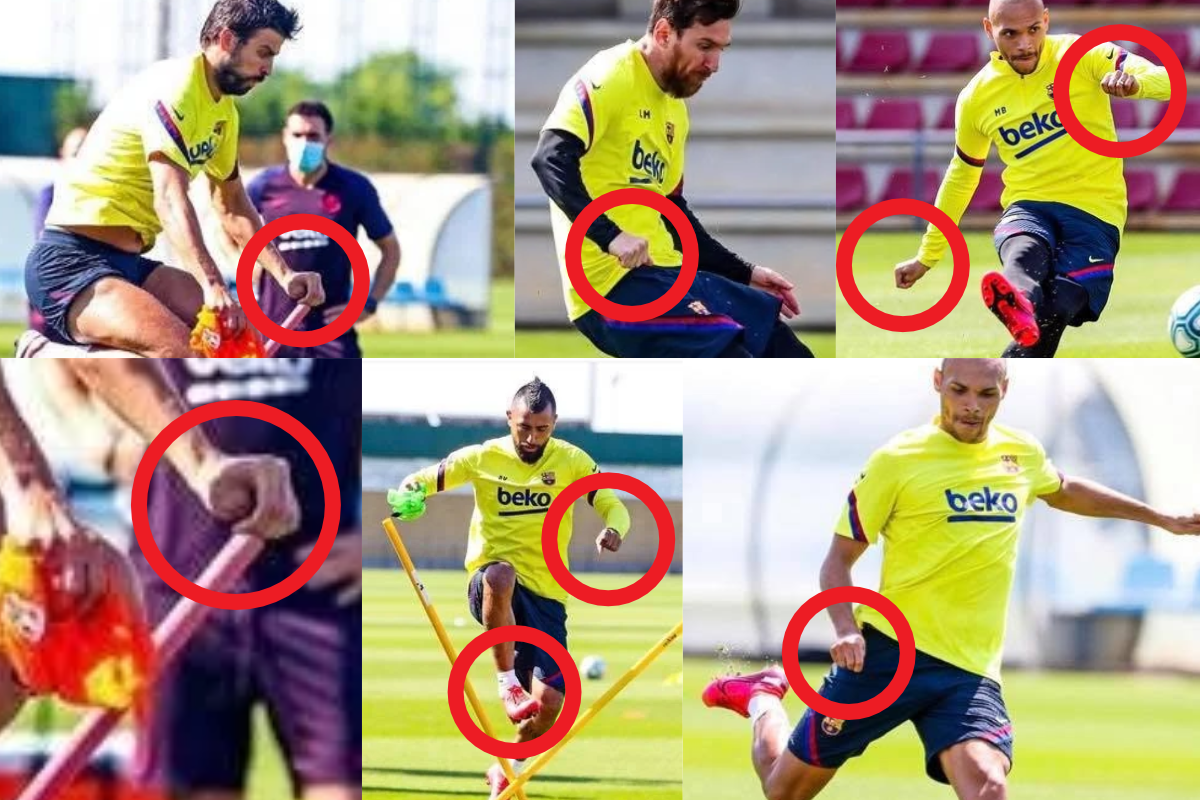
Now ask yourself: is any of that pathological?
Of course not. These are some of the most skilled athletes in the world, moving with extraordinary control. If I told them they were playing soccer pathologically because their thumbs were tucked, they would laugh at me.
They are stabilizing. When a task gets hard, the body recruits tension to create a stable base, so the rest of the body can do what it needs to do at its highest level.
Back To The Baby With The Spoon
So when this mom tells me her daughter's hand twists every time she eats, I see something very similar.
Swallowing is hard work for this little girl right now. Her body hasn't yet organized enough support from within for swallowing to be easy. So it does exactly what Messi's body does: it creates tension. The hand twists, the back extends and the head turns. Together they build longer lines of tension through her body, and those lines give her the stability to swallow.
The key detail is that she isn't like that all the time. The pattern shows up when something is hard for her. That tells us what it is. It isn't random, and it isn't damage. It's a strategy.
That's why I told her mom something that may sound surprising:
If we fight the hand, we don't make the pattern go away. We just hide it.
If we hold the hand down or put something in place to stop it from twisting, she'll have a firmer wall to push against. On the outside, the hand looks better. Inside, the tension is still there, because the reason for it hasn't changed. Her body still needs that stability to swallow.
You can fight the hand a hundred times. Until we understand why it's there, it won't go away.
Function Over Shape. Always.
When I'm asked what matters most, my answer is always the same:
I choose function over shape. Always.
The shape we see is the body showing us the best, most efficient way it has found to perform right now, with the support it has. That's true for a professional athlete taking a shot on goal, and it's true for a baby learning to swallow a spoon of puree.
When we take that shape away without giving the body something better, we take away its strategy. The body still needs stability, so it will brace somewhere else or lose what it was able to do.
If you've read my earlier post on spasticity and fascia, this will sound familiar. Tone isn't simply something to turn down or stretch away. It's deeply connected to how much support your child's body has from within. It's also why we don't stretch in cerebral palsy: pulling on a tight muscle doesn't give the body the support it's missing.
So What Did I Tell This Mom To Do?
I didn't tell her to fight the hand, and I didn't tell her to ignore it. I told her to understand it.
Her daughter's hand is showing us where her body needs more support. So instead of working on the hand, we work on the support underneath it, through small movements to feed fascia, done gently and consistently at home with her own hands. As that support grows, the body won't need to grip as hard to do something difficult.
Here's what I'd invite you to try if your child tightens a leg while using their hands, fists a hand while concentrating, or twists their body while eating:
Notice when it happens. Is it there all the time, or mostly when something is hard? If it shows up with effort, you're likely seeing a stabilizing strategy.
Get curious before you correct. Ask yourself: What is this helping my child do right now? As I wrote in Before We Ask Children to Do, Help Them Be, support comes before performance.
Put your energy into support. Your hands at home can build what your child's body is asking for. Once that support is there, the body doesn't have to hold on so tightly.
If this way of thinking is new to you, Stop Fixing, Start Trusting is a good next read. If you're curious what our calls are really like, you can read more in Inside a TheraParent Coaching Call.
In my next post, I'll go deeper into why the body works this way: how it holds itself together as one tension system, and what happened for a teenager who started bearing weight on both hands without ever practising it.
That young mom with the spoon is just beginning, and so is her daughter. When I watched her daughter's videos, I didn't see a body doing something wrong. I saw a body working very hard to do something difficult, and finding a way.
Messi's body does the same, and so does your child's.
Ready to Start?
Take your first step into fascia therapy with our short, parent-friendly workshop:
The #1 Fascia Therapy To Improve Torso Control. I teach you the first exercise and how to make the binder so you can help your child today.
Gentle, effective, and easy to begin—no experience needed.
Want to Go Deeper?
If you’re ready to fully embrace this gentle approach and receive personalized support, apply for TheraParent Coaching—our therapeutic coaching program designed for dedicated parents like you.
Includes weekly calls, a tailored plan, and a supportive community.
Apply here – it’s free to explore.
Stay connected and inspired every week.
Subscribe to our weekly blog updates and receive new posts, encouragement, and fascia therapy tips right in
your inbox. So never miss the support and ideas that can make a difference in your journey.
