
Post 75: When Your Heart Says No: Old Models, New Understanding, and the Courage to Trust Yourself
Have you ever done something for your child because you were told it was the right thing, while a quiet voice inside you kept saying no?
Maybe it was a brace. A stretching routine. A position your child cried through. You kept going, because the people recommending it were the experts, and because you love your child and want to give them every chance.
But that quiet voice didn't go away.
I hear this so often. In workshops, in webinars, in my office. A parent tells me, "I'm doing this because the doctor told me to. But my child cries, and I cry, and I don't like it."
If that sounds familiar, this post is for you.
A Family at My Door
Recently, a new family came to my office. They were from out of town, in the middle of an intensive therapy program, and someone had told them about me. They came for an osteopathic assessment, not really knowing what to expect.
When I opened the door, I saw a mom, a dad, and their little boy. And on the parents' faces, I saw one thing above all: We are exhausted.
As I gently showed them a few simple things about their son's body, I noticed he was walking in two brand-new AFOs. I asked about them. And his mother began to share. Her son wasn't doing well with them. But that was what they had been told to do. They had just spent $5,000 on them.
I didn't want to tell her to stop using them. They were new to this way of seeing the body. They had just made a big investment based on advice they trusted. It wasn't my place to undo that in one visit.
So instead, I asked her one question:
"What does your heart tell you?"
She started to cry. "I don't like the AFOs."
The Weight Parents Carry
That moment stayed with me all night. I felt it in my own chest.
Here was a family doing everything they had been asked to do, trying so hard to find the good in it, and feeling inside that something wasn't right. Their plate was already so full. Full of appointments, recommendations, and people asking them to do things they didn't want to do.
So I didn't add more. I gave them a ball and a pillow to take home, and a blog post to read. I told them: when you finish your program and get home, read this. Start with one exercise. And if you like it, then we can do more.
That's all I felt I could offer. Not another obligation. Just an open door.
What I wanted to tell that mother, and what I want to tell you, is this: the feeling in your chest matters. Not because it's always right about every detail, but because it's information. It's telling you that what you're doing and what you're feeling are no longer in agreement.
Why Good People Give Different Advice
Before we go further, I want to say something important. The doctors and therapists who recommend braces, stretching, and other interventions do it from a good heart. They want to help your child. No one is coming at your child to cause harm.
But the advice they give is based on a model of the body. And that model is incomplete.
I know this model well, because it's the one I studied when I first became a physiotherapist. I practiced from it for years.
The Old Model: Tables, Screws, and Hinges
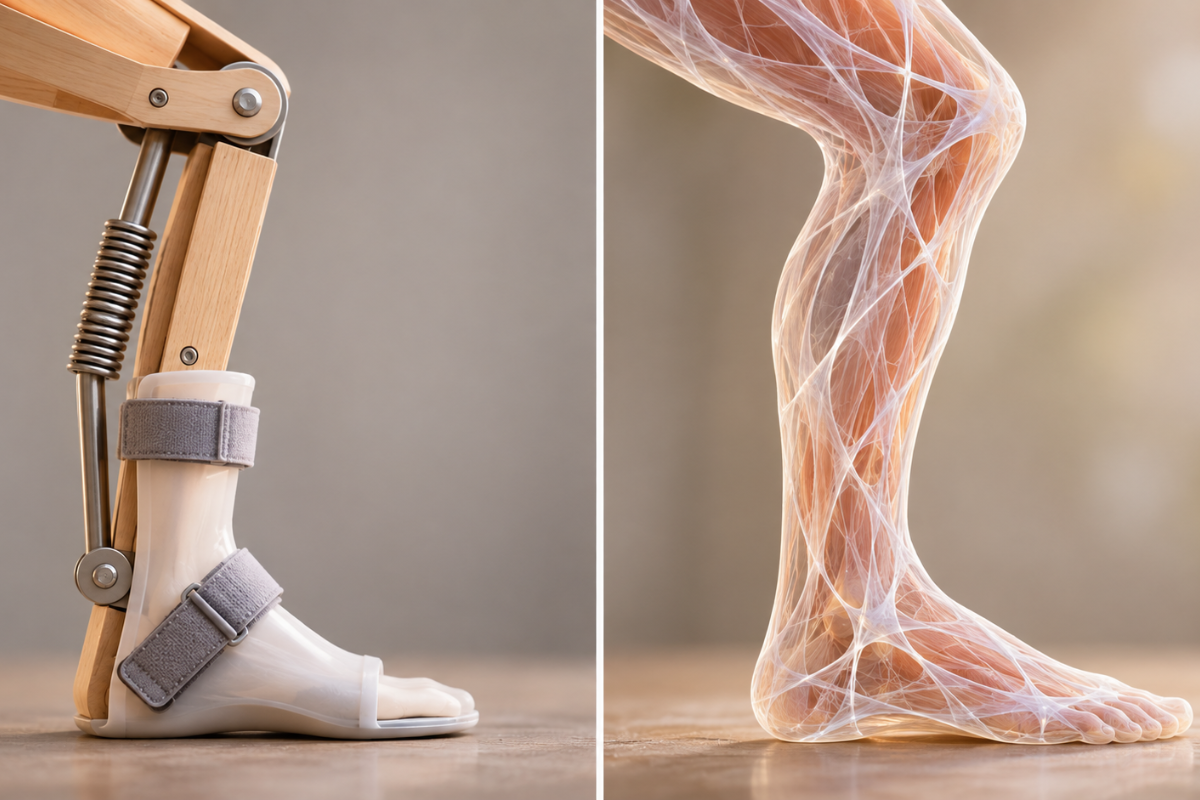
The traditional way of understanding movement is a biomechanical model, borrowed from the physics of hard, non-living objects. Think of a table held together by screws, or a door swinging on a hinge. In this view, bones are levers, joints are hinges, and muscles are motors.
So when something isn't moving the way we expect, the logic is to strengthen it, stretch it, or hold it in place. Within that model, an AFO makes perfect sense: if a foot isn't positioned the way we expect, we hold it in the "right" position.
The New Model: We Are Soft Matter
Biotensegrity offers a very different picture, and it is the model that informs everything we do here at WeFlow. The body isn't a stack of parts. In this model, bones float within a continuous, tensioned web formed by fascia, muscles, ligaments, and fluids. When a force acts on one area, the strain spreads through the whole system instead of staying in one place.
We are not made of wood and screws. We are soft matter: flexible, responsive, and alive. Joints don't move around one fixed pivot point, and every joint depends on the stability of the whole body around it. When the fascial system is depleted, it can't offer enough support, and we see abnormal tensional patterns instead.
Seen through this lens, a foot that turns or a body that tightens isn't simply something to hold in place. It may be the body's way of finding stability it doesn't yet have. And when we block movement completely, the body has even fewer options to organize itself.
That doesn't mean every brace is wrong. Some children truly need their AFOs to walk, especially when their bodies have been changed by past surgeries. If a tool is part of how your child functions and participates in life, it has a place. The question isn't "brace or no brace." The question is: Do I understand why I'm using this, and does it feel right for my child?
It Took Me Two Years
I want to be honest about something. When I began learning this new model, there was a fight in my own head.
It took me two years to let go of the old way of thinking. Two years of being willing to change, because what I was seeing in children was too obvious to ignore.
Today, when I teach professionals, I tell them: put your knowledge on a shelf. Not in the trash. On a shelf. Let the new understanding in. Experience it. Feel it in your own hands. Then, once you've integrated it, open the shelf again. Bring back what still fits, and leave behind what no longer serves you.
If it took me two years as a trained professional, please be gentle with yourself as a parent. You don't need to understand everything at once. You're allowed to be in between. You're allowed to be learning.
Coherence: When What You Feel Matches What You Do
After many years working with families, here's what I've noticed.
The families who seem most at peace aren't necessarily the ones who chose one path or another. They're the ones whose choices feel coherent. What they do with their child matches what they feel inside.
These families are empowered. They're informed. They have guidance. They ask questions. They don't make decisions from fear, and they don't simply follow along because it's easier.
And I won't pretend it's easy. It's often simpler to follow what you're told and say, "That's just the way it is." Standing in your own clarity takes education, support, and courage, especially when the pressure around you is strong.
But it doesn't have to be a fight.
One mother in our community shared how a seating clinic recommended a fully restrictive wheelchair for her daughter. It didn't feel right to her. She told them it felt like there was no life in it. Rather than arguing, she listened with an open heart, thanked them, and asked for more time. She kept doing the work at home. Six months later, the same clinic told her that her daughter now needed only mild to moderate support, and sent her a whole new list of options.
She didn't need to win an argument. She trusted what she felt, kept going, and let her daughter's progress speak.
Listening to Your Child, Too
There's one more voice to listen to: your child's.
Your child is telling you what they like and what they don't. Their body is communicating with you all the time. When a child cries, resists, or tightens every time something is done to them, that's worth noticing.
This applies to my work too. Some children don't like fascia work at first. Our job then is to find a gentle way in, an entrance that feels safe enough for them to accept. And over time, something beautiful often happens. Parents tell me their child now asks for the exercises. For many families, that's never happened before with any therapy.
That's coherence too: when what we do for our children feels good to them as well.
A Gentle Invitation
If you're carrying a decision right now that doesn't sit right in your chest, I'm not going to tell you what to do. That choice belongs to you.
But I'd love to invite you to pause and ask yourself a few questions:
What does my heart tell me about this?
Do I understand why this is being recommended, and which model of the body it comes from?
How does my child respond to it?
If I imagine stopping, what do I feel: fear, or relief?
You don't have to fight anyone. You simply need to understand why you're doing what you do, and let what you feel and what you do come back into agreement.
You are the one who knows your child best. Your heart, your observations, and your love are not obstacles to good care. They are part of it.
Ready to Start?
Take your first step into fascia therapy with our short, parent-friendly workshop:
The #1 Fascia Therapy To Improve Torso Control. I teach you the first exercise and how to make the binder so you can help your child today.
Gentle, effective, and easy to begin—no experience needed.
Want to Go Deeper?
If you’re ready to fully embrace this gentle approach and receive personalized support, apply for TheraParent Coaching—our therapeutic coaching program designed for dedicated parents like you.
Includes weekly calls, a tailored plan, and a supportive community.
Apply here – it’s free to explore.
Stay connected and inspired every week.
Subscribe to our weekly blog updates and receive new posts, encouragement, and fascia therapy tips right in
your inbox. So never miss the support and ideas that can make a difference in your journey.
