Post 72: More Than Head Control: The Hidden Benefits of a CP Neck Support
This week, on one of my coaching calls, a mom unmuted herself with news she could barely hold in.
Her son had slept through the night. He fell asleep just after nine and woke up a little before seven. She couldn't remember the last time that had happened. "I felt reborn," she told us.
I've been doing this work for over 27 years, and moments like that still move me. What moved me even more was what came next. One by one, other parents started sharing what they were seeing at home. So many of those changes came from one simple tool that their children were just wearing: the neck support.
There was no technique and no exercise involved. The children only had the support on.
I want to share what these families told me, why I believe it's happening, and how you can learn to bring this support to your own child.
You've Probably Tried So Many Things
If you're reading this, you've likely spent years looking for something that helps. Maybe you've tried equipment that was expensive, bulky, or uncomfortable. Maybe you've watched your child's head drop forward or fall back, over and over, and wondered how hard their body is working just to hold it up.
I know how tiring that search can be. And I know how easy it is to stop believing that something simple could make a difference.
So I'll just share what I heard this week and let you decide.
What Parents Have Been Sharing
"He slept through the night."
That first mom couldn't stop smiling. Her son usually has very disturbed sleep, and that night his body finally rested.
"He was so calm within two minutes."
The same mom told us that when she put the neck support on, her son was very dystonic, twisting and tense. Within two minutes, he was lying flat and calm, his hands open and relaxed. She's now thinking about adding the neck support to his care plan, as something his caregivers can reach for when his body is having a hard time settling.
"It's his favourite thing in the world."
Another mom told us her son comes home from school, sees his neck support, and gets excited. He can't wait to have it on. A parent doesn't usually expect to hear that about a therapy tool.
"It just hugs your head the right way."
One mom made a neck support for herself too. She works on her feet all day as a hairstylist and spends most of it hunched over. She told us that wearing it keeps her upright in a way that feels completely comfortable. "It holds you," she said. When parents feel it on their own bodies, they understand right away why their children relax into it.
Why Something So Simple Can Do So Much
When parents first see the neck support, most of them think it's there to hold the head up. It does help with that. But there's a lot more happening.
The base of the skull is a very special area. It's where the vagus nerve leaves the skull, and that nerve is closely connected to the body's ability to rest, digest and feel safe. I wrote more about this in my post on the DIY head support.
It's also an area I've worked with for many years through my training in craniosacral therapy and cranial osteopathy. In craniosacral work, there's a technique called a still point. It uses very gentle, specific contact at the base of the skull to help the nervous system settle and reset.
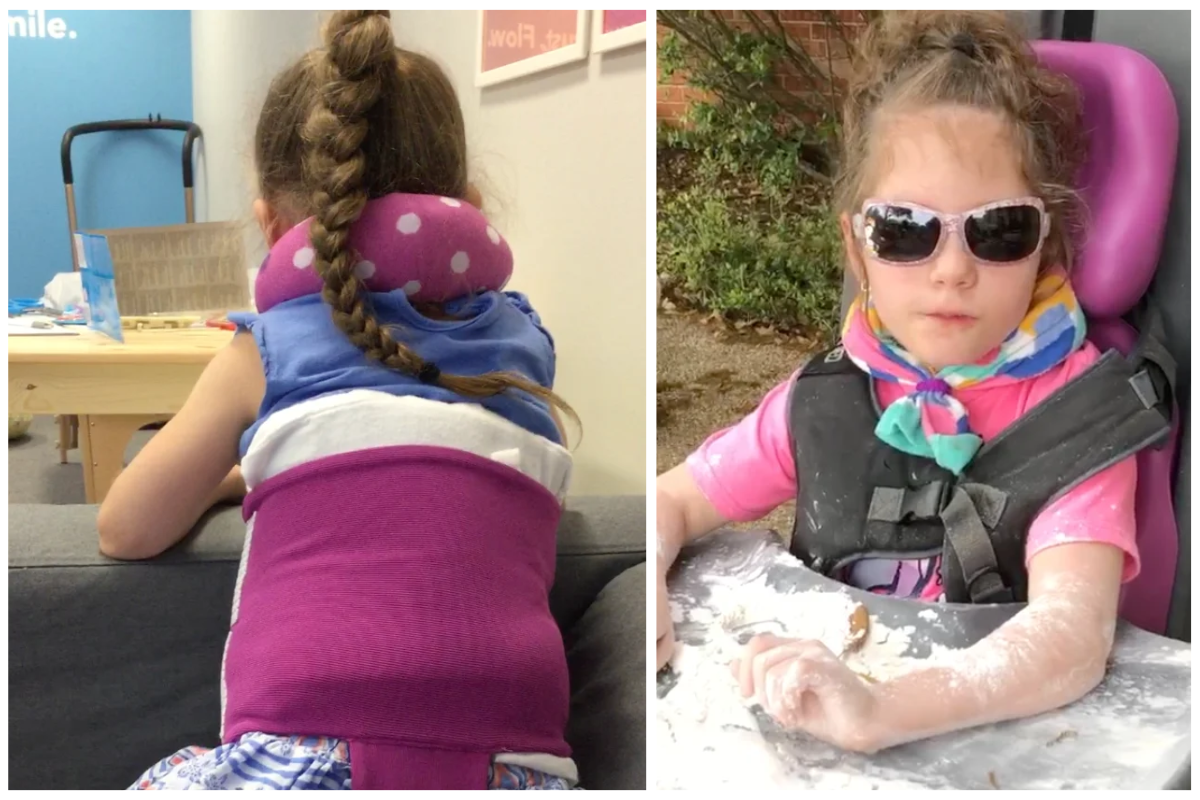
When your child wears the neck support, a softer version of that contact is happening all the time. Every time their head moves against the chair, the bed or your arms, the support gently meets the base of the skull. For a child whose nervous system is often working in overdrive, that steady, soft input may be the signal their body has been waiting for. It tells them they are supported and that it's safe to let go.
That's why, for some children, the change shows up in their sleep. For others, it shows up as calm, or as a softer body, or as a child who suddenly wants the support on.
More Sounds, Easier Swallowing
Another parent asked me a great question this week. Her daughter becomes much more vocal after having the neck support on. Was that expected?
Yes, it often is. In craniosacral therapy, the neck and throat area is sometimes called the avenue of expression. When we bring gentle support to this area, many children start to vocalize more.
Over time, parents I work with often tell me their children are making new sounds, or that the sounds they make have changed. Families of children who eat by mouth sometimes notice their child handling crumbs or different food textures more easily, or swallowing with less effort. Every child is different, and I never want to promise a specific result. But these are some of the most common things I hear as families keep going.
It Keeps Working All Day
Something I love about the neck support is that it keeps working without you doing anything else. It's there in the high chair, in the car, at school or in the wheelchair. Every time your child moves, it's offering that soft input.
I wrote about this in my post on the binder and passive fascia tools. On the days you can't do anything else, putting the neck support on is still something real you're giving your child's body.
I've also heard from therapists who use it in their own work. An occupational therapist once shared that simply having the children in her classroom wear neck supports made them calmer and more attentive.
Bring This Support to Your Child
The parents who shared their stories this week didn't start with anything fancy. They started with simple support and a little bit of trust. Within days, some of them were watching their children settle, sleep and soften in ways they hadn't seen in a long time.
I'd love for you to experience that with your child too.
I created a free Neck Support Course where I walk you through the rationale behind it: why it works, what it's doing in your child's body, and how to make it part of your child's day.
Request Your Free Neck Support Course Here
I'd love to hear what you notice.
Ready to Start?
Take your first step into fascia therapy with our short, parent-friendly workshop:
The #1 Fascia Therapy To Improve Torso Control. I teach you the first exercise and how to make the binder so you can help your child today.
Gentle, effective, and easy to begin—no experience needed.
Want to Go Deeper?
If you’re ready to fully embrace this gentle approach and receive personalized support, apply for TheraParent Coaching—our therapeutic coaching program designed for dedicated parents like you.
Includes weekly calls, a tailored plan, and a supportive community.
Apply here – it’s free to explore.
Stay connected and inspired every week.
Subscribe to our weekly blog updates and receive new posts, encouragement, and fascia therapy tips right in
your inbox. So never miss the support and ideas that can make a difference in your journey.
