
Post 74: Why Is My Child Getting Tighter? When Tightness Is the Body's Solution
You notice it first in small moments.
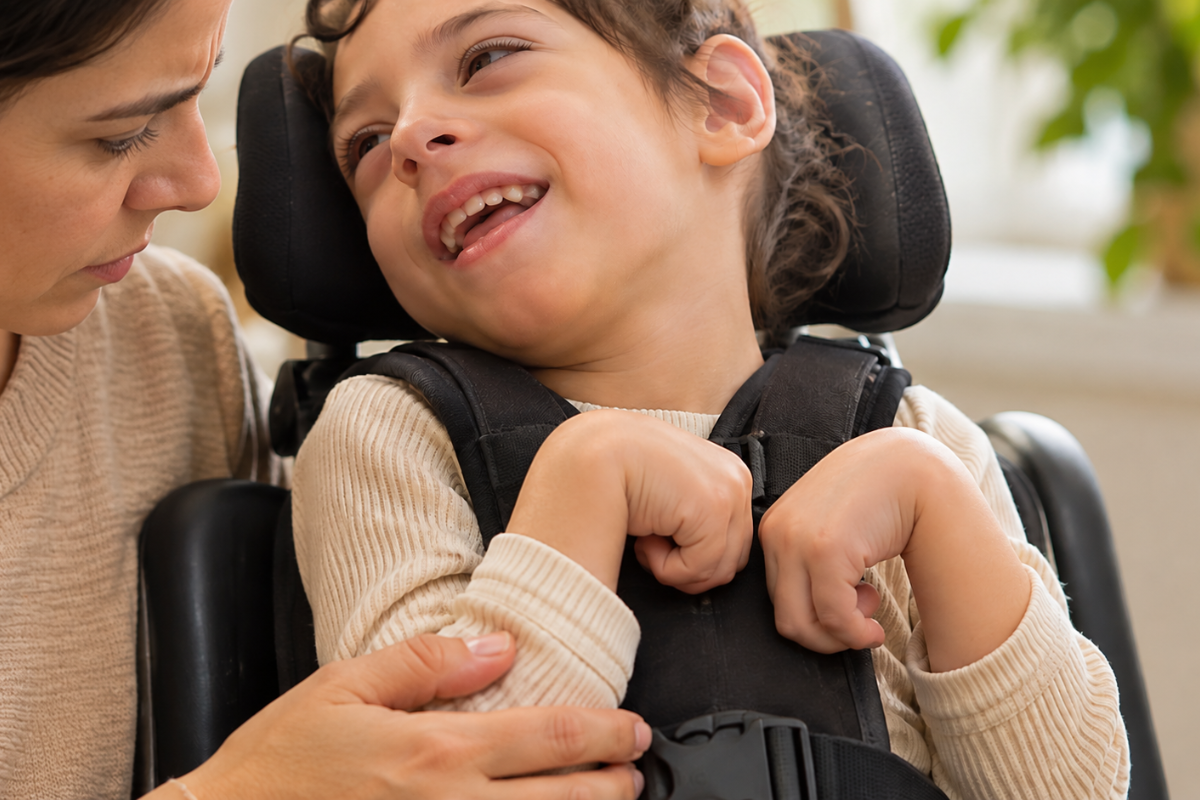
Her hands curl in a little more than they used to. Her feet turn inward when she gets upset. He arches his back with every spoonful at mealtime. And then the worry arrives, quietly at first: We're doing so much. Why is my child getting tighter?
Maybe a doctor has already noticed it too. Maybe the conversation has turned to braces, or stretching, or another referral. And somewhere in the middle of all those recommendations, you're left holding the same question, wondering if you've missed something.
You haven't. I want to offer you a different way of looking at what you're seeing, one that has changed how I work with children and families after many years in this field.
What you're seeing as a problem may not be a problem at all. It may be the solution your child's body has found.
A Body That Is Always Looking for Stability
Every body, including yours and mine, needs stability before it can move freely. This isn't a rule we impose. It's how the body is built.
For a long time, we imagined the skeleton as a kind of scaffolding: bones stacked on top of each other, held in place by joints, moved by muscles. But that picture is incomplete. Your child's bones are actually suspended inside a living, connected web of tissue called fascia. Each vertebra in the spine, for example, is held in place by the tension of the system around it.
I like to picture it as a structure made of elastic bands with anchor points. When the bands have the right amount of tension, everything stays steady and supported, and the whole structure can still move. This is what we call biotensegrity: how the body distributes tension and support as a whole system.
Now imagine those elastic bands are loose. The structure can't hold itself steady anymore. The spine shifts and travels. Nothing feels secure.
This is what I see in so many of our children. A depleted fascial system is not capable of offering enough support to the body, and we see abnormal tensional patterns instead.
Many of our little ones, when they are very young, feel soft and floppy, almost like jello without enough consistency. Their fascia simply doesn't have enough structure yet to hold them.
What Happens When We Ask for More Than the Body Can Give
Here is where the story usually turns.
With the very best intentions, we start asking these children to do things. Lift your head. Hold yourself up. Sit. Stand. Bear weight. Every therapist, doctor, and parent involved wants to help the child move forward.
But the child's fascia can't yet handle those demands. And because the body is incredibly smart, it finds another way. It recruits tone. It tightens. It creates its own stability wherever it can, because it has been asked to perform, and it will do what it takes to perform.
So the child does lift their head. But now they're held in that position, without freedom. When they try to turn or move, the tension stays, because letting go of that tension would mean feeling unsupported and exposed again. The body has built a source of stability and it doesn't want to give it up.
In my experience, the tightness we see in our children is closely related to the demands we place on them. The more we push, the tighter they often become.
I say this with humility, because I worked this way myself for many years. I was trained in the same model. It took me time, and a lot of watching children closely, to see what their bodies were really telling me.
What This Looks Like at Home
Once you understand tightness as a search for stability, you may start to see it everywhere. Here are a few examples parents shared with me recently.
Feet turning in when your child is stressed. One mother noticed her daughter's feet bending inward and her hands stiffening, especially during difficult moments. That inward turn is the body creating stability when it doesn't feel secure enough on its own.
Arching during meals. The same little girl arched her back while learning to eat from a spoon. Managing food in the mouth is a fine motor skill, and fine skills need a stable base. That arching was her way of tightening the passages the food needs to travel through. It wasn't defiance or a "bad reflex." It was her body organizing itself to swallow.
The most helpful response here wasn't to stop the arching. It was to give her the stability she was looking for, so she wouldn't need to create it herself: supporting her torso with a binder, adding neck support, and having the person holding her offer gentle, steady support through her body.
Relaxed at rest, tight in action. This is one of the clearest clues. If your child is relaxed when nothing is being asked of them, and the tone kicks in the moment they get excited or try to do something, that tells us something important. The tightness isn't stuck there. It's a strategy the body uses when it needs extra stability.
Why "More Control" Isn't Always the Answer
When we see tightness as the problem, the natural response is to control it: hold the foot in place, stretch the arm, limit the movement.
These options come from people with good hearts who truly want to help. But they're based on an older model of the body, one borrowed from the physics of hard objects. A table stays stable because of screws and nails. A door opens on a hinge. For a long time, joints were described the same way, as if each one moved around a fixed pivot point.
We now understand that the body doesn't work like a table or a door. We are soft matter. Our tissues are flexible and responsive. Even bone is a denser form of this connected tissue. The space between bones changes as we move, and every joint depends on the stability of the whole body around it.
So when we only address the tightness itself, we may be ignoring why the body created it in the first place. And when we block movement completely, the body often has even fewer options than before.
I want to be clear: some children truly need their braces or equipment to function in daily life, and that's okay. If a tool is part of how your child walks, sits, or participates in life, it has a place. What matters is understanding what you're using it for, and noticing whether it supports your child's body or simply holds it still.
The Other Side: When Stability Comes From Within
Here is the hopeful part of this story.
When we give the body what it's really asking for, which is support and structure from the inside, it no longer needs to hold on so tightly.
I often describe fascia as a mesh. In many of our children, that mesh starts out loose. With small movements to feed fascia, done consistently over time, the mesh becomes more woven. Those new connections give stability to the joints. Sometimes, during this weaving phase, things can even look a little tighter for a while, because the new connections are pulling the system together. Freedom and separate, independent movement tend to come later, once that inner structure is in place.
I saw this beautifully in our community recently.
A grandmother shared that her granddaughter, a little girl who had always kept her arms and legs curled close to her body, reached out and wrapped her arm around her grandmother's arm. Then she did it with her other hand, the one that isn't her stronger side. And then one morning, as her grandmother picked her up, this little girl put both arms around her and gave her a real hug.
For years, this child's body found safety by staying curled in. That was where she felt stable. Now that her center is more organized, she dares to open. She dares to reach.
Think about it: if you don't feel your own body clearly, if you're busy just trying to hold yourself together, how could you reach out to show someone you love them? When a child feels stable inside, they're free to turn their attention outward. To interact. To make choices. To express themselves.
A Different Question to Ask
If you're seeing more tightness in your child right now, I'd love to invite you into a gentle shift.
Instead of asking, "How do I stop this?", try asking, "What is my child's body trying to stabilize?"
Start by simply observing:
When does the tightness appear? At rest, or when something is being asked of your child?
What is happening right before it shows up? Excitement, effort, eating, transitions, discomfort?
Is your child being asked to do something their body may not yet have the support for?
These observations don't require any special equipment. They just require curiosity and your attention, which you already have.
And one more thing. If something you're doing with your child doesn't feel right in your chest, if your child cries and you cry and something inside you keeps saying no, please pay attention to that. You don't need to fight anyone. You simply need to understand why you're doing what you do, and let what you feel and what you do come back into agreement. Your child is also telling you what they like and what they don't. Their body is communicating with you all the time.
You Are Already Part of the Answer
Tightness can feel scary, especially when it seems to be getting worse. But it may also be your child's body showing you just how intelligent it is, finding a way to cope with what it's been given.
The goal isn't to force that tightness away. It's to create better conditions for development, so your child's body doesn't need to hold on so hard. And that can begin at home, with your own hands, through small movements to feed fascia and support that meets your child where they are.
You are not behind. You haven't missed your chance. Every day is an opportunity to see your child's body through a new lens, and to trust its natural capacity to reorganize.
Ready to Start?
Take your first step into fascia therapy with our short, parent-friendly workshop:
The #1 Fascia Therapy To Improve Torso Control. I teach you the first exercise and how to make the binder so you can help your child today.
Gentle, effective, and easy to begin—no experience needed.
Want to Go Deeper?
If you’re ready to fully embrace this gentle approach and receive personalized support, apply for TheraParent Coaching—our therapeutic coaching program designed for dedicated parents like you.
Includes weekly calls, a tailored plan, and a supportive community.
Apply here – it’s free to explore.
Stay connected and inspired every week.
Subscribe to our weekly blog updates and receive new posts, encouragement, and fascia therapy tips right in
your inbox. So never miss the support and ideas that can make a difference in your journey.
