Post 65: Why the Therapy Ceiling Exists — And What Your Child's Body Is Actually Asking For
Part 3 of 5 — What Every Parent Should Know to Truly Help Their Child Improve Movement, Posture, and Quality of Life
There's a moment most families know well.
Progress is happening. Real, visible progress — a little more stability, a little more ease, something that wasn't there before. You feel it. The therapists see it. You let yourself hope.
And then it stops. Not regression necessarily — just a ceiling. A point where no matter how consistent the work, how committed everyone is, how many sessions happen each week, the gains don't continue. Things hold, but they don't grow. The ceiling becomes the floor.
If this sounds familiar, I want you to know: this is one of the most common experiences families share with me. And it has a specific explanation — one that has nothing to do with how hard your child is trying, or how good your therapy team is.
It has to do with which layer of the body the work has been reaching.
The Model Most Therapy Is Built On
Every approach to therapy — strengthening, stretching, facilitated movement, positioning — was designed around a particular understanding of how the body works.
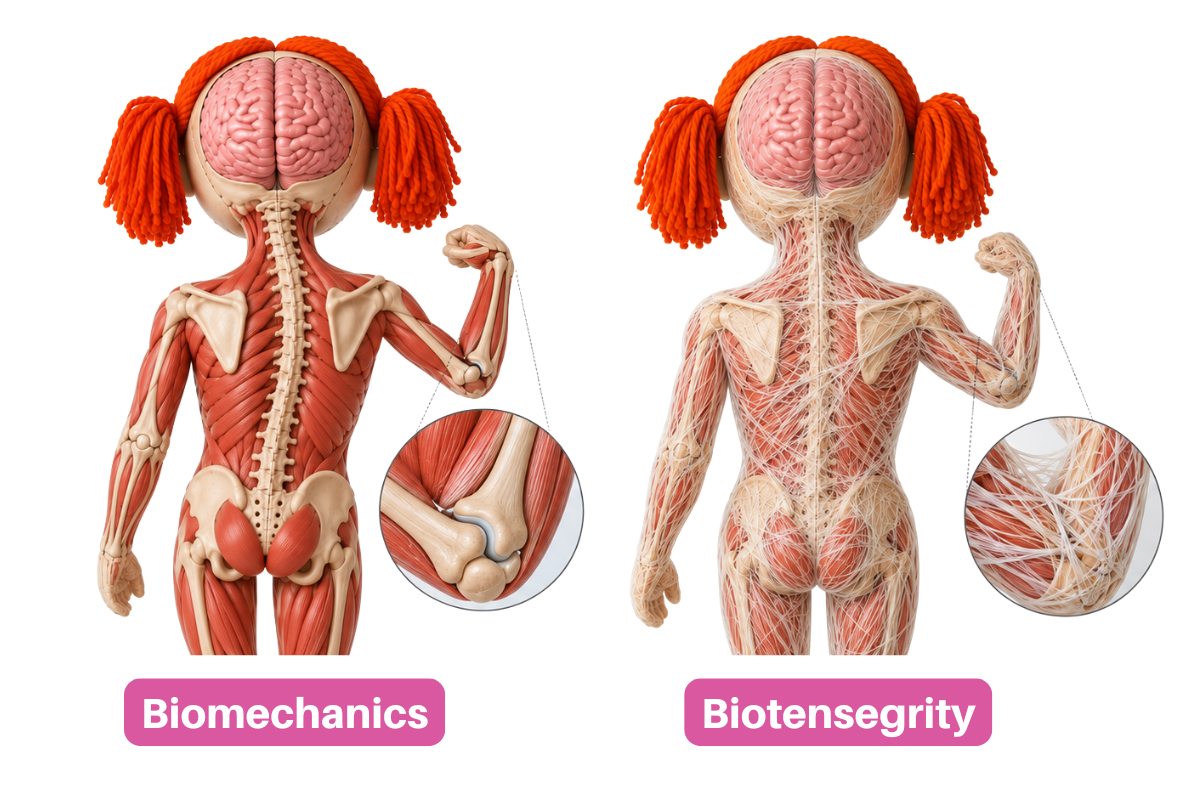
That understanding is called biomechanics. And in broad terms, it goes like this: the brain sends signals to the muscles, muscles move joints, joints create posture and movement. When there is a brain injury — as in cerebral palsy — those signals are disrupted. Movement becomes harder to initiate, control, and coordinate. And so therapy focuses on training the muscles and joints to compensate for what the brain can no longer direct as it should.
This model isn't wrong. The brain does direct movement. The neurological piece is real and it matters. Strengthening, facilitation, and repetition all have a place in supporting a nervous system that is working harder than it should have to.
But it is incomplete. Because it was built before we understood what fascia actually does.
When we see the body only through a brain-muscle-joint lens, we focus our efforts there. We work hard, and we get results — up to a point. And then we reach the ceiling. Because the layer underneath — the connective web that gives the body its internal shape and tensional balance — was never part of the picture.
Working on muscles and joints without addressing fascia is like painting the walls of a house whose foundation is shifting. The paint job matters. But it won't hold until the foundation is stable.
Why Stretching Tight Muscles Often Doesn't Last
This is the question I hear from parents again and again: we stretch every day, but the tightness always comes back. Why?
Here is what's actually happening.
When the fascial system loses its tensional balance — when the jello softens and the internal scaffolding collapses — the body reaches for muscle tone to create stability. The muscles tighten not because they are inherently too short or too stiff, but because they are compensating. They are the body's emergency response to a foundation that isn't holding.
When we stretch that tight muscle, we are addressing the symptom. We are releasing the compensation. And for a moment, the tone goes down — because the stretch brought temporary relief.
But we didn't address what caused the tightness. The fascial system is still under-supported. So the body reaches for tone again. The muscle tightens again. And we find ourselves stretching the same areas, week after week, with the same temporary results.
There is also something more specific worth knowing: when we apply force to fascial tissue — pulling it, stretching it hard — the tissue can actually become weaker, not stronger. Fascia responds to gentle, consistent mechanical input. Force works against it. This is why an approach built on force alone so often creates a ceiling: it's asking the tissue to respond in a way it isn't designed to.
You can read more about why this matters specifically for tight muscles in CP in this post, which goes deeper into the stretching question.
What The Body Actually Responds To
Inside the fascial system, there are cells called fibroblasts. Think of them as the builders — the tiny spiders continuously spinning and maintaining the connective web.
These cells are designed to respond to one specific kind of input: small, gentle, consistent movement. Not force. Not repetition to exhaustion. Small movements — the kind that gently feed the tissue and tell those cells: keep building, keep organizing, this area needs support.
When fibroblasts receive that input, they lay down collagen. They strengthen the web. The jello becomes firmer. The internal scaffolding begins to hold.
And when the scaffolding begins to hold, something changes in the whole system. The muscles don't need to compensate as much. The tone that was there to create stability begins to ease — not because we stretched it away, but because the body no longer needs it in the same way. The posture that keeps collapsing starts to find itself, because there is something real underneath to support it.
This is a different kind of change. It comes from a different direction. And it tends to last in a way that surface-level work alone often doesn't.
This Doesn't Mean Starting Over
I want to be clear about something, because I think it's important.
Understanding the role of fascia doesn't mean that everything your child has received up to now was wasted. It wasn't. The strengthening, the therapy, the positioning — all of it contributed something. And it can continue to contribute.
What changes is the question we're asking. Instead of: how do we strengthen and stretch the body into better organization? We add: is the connective foundation underneath strong enough to hold what we're building on top of it?
When we begin working at that level — gently, consistently, with the right kind of input — the ceiling often begins to lift. Not because we found a miracle. But because we finally reached the layer that was waiting to be addressed.
For many families, this is the moment things begin to feel different. Not louder or more intense — quieter, actually. Steadier. Like the work is finally landing somewhere that holds.
If you're curious what those early changes actually feel like to notice, this post on the first wins of fascia therapy is a gentle read for this moment.
The Question That Opens A New Door
If the approach your child has been receiving is working beautifully, keep going. This isn't about replacing what works.
But if you keep hitting the same ceiling — if progress stalls, if tone keeps returning, if you feel like you're maintaining rather than moving forward — it may be worth asking: have we been working on the right layer?
That question is the beginning of a different conversation. One that leads somewhere new.
In the next post, we'll talk about who is actually best positioned to do this work — and why the answer might surprise you.
Next week: Why you — not another specialist — may be the most important therapist in your child's life.
And if you'd like to understand more about how fascia and the beyond-stretching approach connect, this post is a good companion read.
Ready to Start?
Take your first step into fascia therapy with our short, parent-friendly workshop:
The #1 Fascia Therapy To Improve Torso Control. I teach you the first exercise and how to make the binder so you can help your child today.
Gentle, effective, and easy to begin—no experience needed.
Want to Go Deeper?
If you’re ready to fully embrace this gentle approach and receive personalized support, apply for TheraParent Coaching—our therapeutic coaching program designed for dedicated parents like you.
Includes weekly calls, a tailored plan, and a supportive community.
Apply here – it’s free to explore.
Stay connected and inspired every week.
Subscribe to our weekly blog updates and receive new posts, encouragement, and fascia therapy tips right in
your inbox. So never miss the support and ideas that can make a difference in your journey.
