Post 64: Why Your Child's Posture Keeps Collapsing — And Why It Has Nothing to Do With Effort or Willpower
Part 2 of 5 — What Every Parent Should Know to Truly Help Their Child Improve Movement, Posture, and Quality of Life
You've seen it happen a hundred times.
Your child is sitting upright — supported, positioned carefully, looking organized. And then, slowly or suddenly, the whole thing gives way. The chest drops. The pelvis slides. The head falls forward. And no matter how many times you reposition them, the collapse comes back.
Or maybe it's this: after months of hard work, real progress — and then a growth spurt, an illness, a difficult few weeks — and you're back where you started. Sometimes further back.
If you've been wondering what you're doing wrong, I want you to hear this clearly: you are not doing anything wrong. And your child is not failing.
What's happening has a structural explanation. And once you understand it, everything you've been observing starts to make a different kind of sense.
The Body Can't Hold Posture With Muscles Alone
In last week's post, we talked about fascia — the continuous connective web that runs through your child's entire body, holding all the parts in their right place, like fruit suspended in jello.
When that system is working well, the body has internal scaffolding. The bones stay where they belong. The spaces between the ribcage, the abdomen, and the pelvis remain open and organized. The child doesn't have to work hard to hold a position — the structure supports itself.
But here's what happens when the fascial system loses its tensional balance — when the jello begins to soften or collapse.
The body still needs to hold itself upright. It still needs to find stability somewhere. And so it reaches for the only other tool it has available: muscle tone.
The muscles tighten. Not because there is something wrong with the muscles themselves, but because they are being asked to do a job they were never designed to do alone. They are compensating for a foundation that isn't holding.
This is why posture collapses even after therapy. The muscles can hold a position for a while — but they fatigue. They can't maintain tension indefinitely. And the moment they release, the collapse returns — because the underlying scaffolding was never addressed.
If you want to understand more about how this specifically affects spasticity and tone, this post goes deeper into that connection.
What The Collapse Actually Looks Like
When I assess a child through a fascia lens, I'm not asking: is the spine straight? Can they hold this position for X seconds? Is the head aligned?
I'm asking a different question entirely: is the jello holding?
And what I see in most children — though it shows up in many different ways — is that the segments of the body are no longer staying in their own space. The pelvis sinks into the abdomen. The abdomen loses its volume and disappears under the ribcage. The chest drops toward the hips. The spaces that should be open and organized start collapsing into each other.
It's not a spine problem. It's not a muscle problem. It's a system problem — the connective web that should be holding all those segments apart and in relationship with each other has lost its integrity.
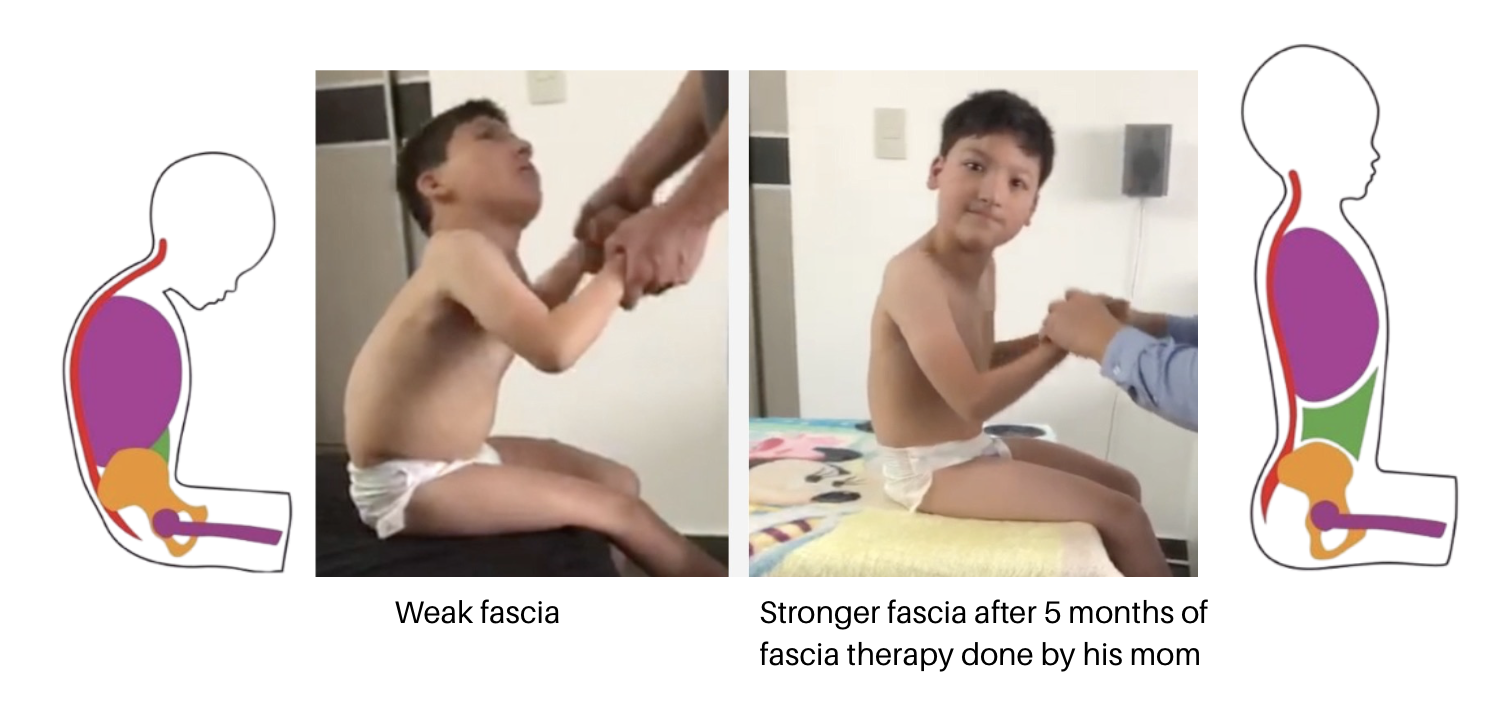
Once you begin to see this, you start to understand why repositioning offers temporary relief but not lasting change. You are rearranging the fruit. But the jello underneath hasn't changed.
For a closer look at how this shows up specifically in posture, head control, and torso stability, this post is worth reading alongside this one.
Why Growth Spurts Take Progress Away
This is one of the most heartbreaking patterns families describe to me — and one of the most common.
Your child makes real gains. Movement becomes a little easier. Sitting feels more stable. You start to feel hope. And then your child grows — and within weeks, sometimes days, the progress fades. The tone returns. The collapse comes back.
Here is why this happens.
When a child grows rapidly, the bones lengthen. But fascia — the connective web surrounding everything — doesn't always keep pace. It gets pulled. It loses its tensional balance. The internal scaffolding that was beginning to find its organization gets disrupted all over again.
It's not that the work you did was wasted. It's that the growth placed new demands on a system that was already fragile, and the fascia couldn't hold.
Understanding this doesn't make it less painful. But it does mean that the answer isn't to work harder on muscles and stretches after every growth spurt. The answer is to continue supporting the fascial system consistently — so it becomes more resilient over time, and less vulnerable to those disruptions.
This is not about effort — it's about the foundation
I want to say something directly to the parent who has spent years doing everything right — showing up to every appointment, doing the home program, repositioning, stretching, advocating — and still feels like they're watching the same collapse repeat itself.
You have been working on the fruit. And the fruit matters.
But the jello — the foundation underneath — has been asking for attention too. And it speaks a different language than strengthening or stretching. It responds to something gentler, more specific, and more consistent.
That's what fascia therapy works with. Not to override the body's patterns, but to support the system underneath them — so the body can begin to organize itself from the inside out.
When that starts to happen, the changes look different. They're quieter, often. Subtler. A little more ease in the breath. A slightly longer moment of uprightness before the collapse. A growth spurt that doesn't take everything away.
Small things — but they are the body beginning to hold itself.
What This Means For What Comes Next
If posture collapse is a fascial story — not a muscle story, not a willpower story — then the approach needs to match.
That doesn't mean abandoning everything your therapy team has recommended. It means adding a layer underneath. Working with the connective web directly, consistently, and gently — so that when your child is asked to sit, to move, to hold a position, there is something real to hold onto.
In the next post, we'll talk about why strengthening and stretching so often plateau — and what the body actually needs in order to create lasting change.
Next week: Why the therapy approaches you've been using keep hitting a ceiling — and what's missing from the picture.
And if you've been doing this work for a while and wondering why progress feels fragile, this post about what the first wins of fascia therapy actually look like might help you recalibrate what to watch for.
Ready to Start?
Take your first step into fascia therapy with our short, parent-friendly workshop:
The #1 Fascia Therapy To Improve Torso Control. I teach you the first exercise and how to make the binder so you can help your child today.
Gentle, effective, and easy to begin—no experience needed.
Want to Go Deeper?
If you’re ready to fully embrace this gentle approach and receive personalized support, apply for TheraParent Coaching—our therapeutic coaching program designed for dedicated parents like you.
Includes weekly calls, a tailored plan, and a supportive community.
Apply here – it’s free to explore.
Stay connected and inspired every week.
Subscribe to our weekly blog updates and receive new posts, encouragement, and fascia therapy tips right in
your inbox. So never miss the support and ideas that can make a difference in your journey.
