
Post 57: The Therapy That Doesn't Ask Anything of Your Child
You sit down next to your child, ready to do "the exercise." You say the words you've said a hundred times — lift your head, try to roll, push up — and you watch their body simply not answer. Not because they aren't willing. Because the message isn't getting through the way it would for another child.
Maybe you've felt that quiet, specific kind of tired afterward. Not just physical tiredness — the tiredness of wondering if you didn't ask the right way, or push hard enough, or find the right motivation. If your child could just try a little more, maybe it would click.
I want to offer you something different to sit with: what if your child doesn't have to try at all for this to work?
You Haven't Missed Anything
So much of the therapy world is built around participation. Follow the command. Hold the position. Repeat the movement. For some children, that's a realistic and valuable part of their progress. But for many of the children I work with — the ones whose bodies aren't yet "listening" the way we'd hope, the ones who can't reliably follow an instruction even when they want to — that ask becomes its own kind of exhausting wall. For you and for them.
If that's where you are right now, you haven't missed anything. You haven't failed to motivate your child correctly. There's simply a layer of support most families have never been shown — one that doesn't depend on your child doing anything at all.
A Different Starting Point
Fascia — the connective web that wraps around your child's muscles, bones, and organs, holding everything in relationship to everything else — doesn't need a command from the brain to begin responding. It responds to gentle, specific, mechanical input. You could think of it as feeding the tissue directly, rather than asking your child's nervous system to organize a movement first.
This doesn't replace the active work — the practicing, the reaching, the rolling. It sits underneath it. It's a way of supporting your child's body even on the days, or in the seasons of life, when active participation simply isn't where your child is.
What "Passive" Actually Looks Like at Home
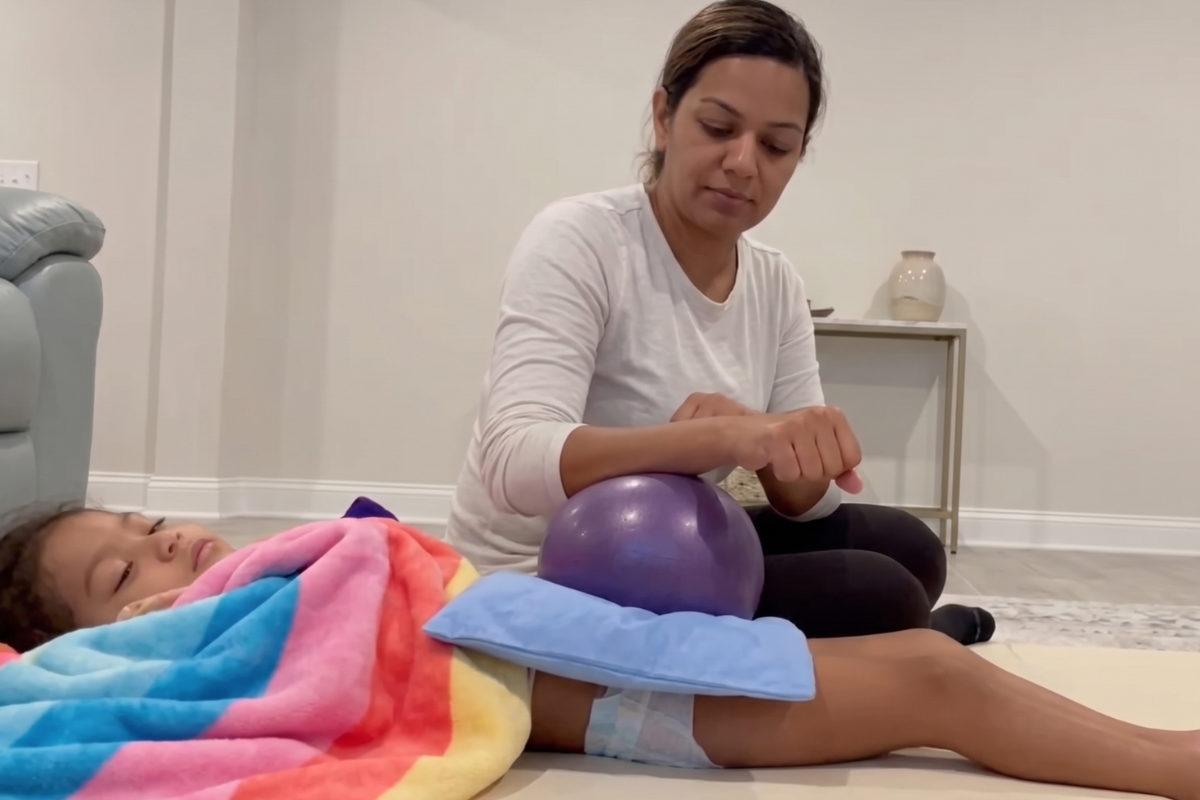
In practice, this means your child can be lying down, sitting comfortably, even resting or sleeping, while you work. You're using simple tools — a soft ball, a pillow, gentle layers of support — to deliver very specific, very gentle input to one area at a time. Your child isn't being asked to hold a position, engage a muscle, or respond on cue. The cells inside the fascia begin to respond to the input itself.
In real homes, this looks unglamorous and calm. Some families have the TV on. Some put on an audiobook. I have one mom in our program who projects her son's show onto the wall instead of a screen, just to keep the room softer while she works. None of that takes away from what's happening in the tissue. The room stays quiet; the child stays comfortable; the work still counts.
If you want the fuller picture of why this gentle, non-stretching approach works the way it does, I've written about it before in Beyond Stretching: A Gentler Approach to Fascia Therapy — this post focuses specifically on what it means for the child who can't actively participate.
Why This Matters Most for the Children Who Are the Most Affected
This way of working tends to land hardest, in the best sense, for the children whose bodies are the most compromised — the ones who can't follow "lift your head" because the signal genuinely isn't reaching that far yet. For these children, passive, fascia-informed input isn't a watered-down version of therapy. It's often the most direct way to begin creating change, because it doesn't require a bridge — the brain-to-muscle command — that hasn't fully formed yet.
And it isn't only for the most affected. Even children with milder presentations benefit from this layer running alongside their active work. It's not either/or.
A Shift in What You're Asking of Yourself
If you take nothing else from this, take this: your job isn't to extract effort from your child. Your job is to show up, consistently, with calm and specific input — to trust your hands doing the work — and let your child's body do what it's capable of doing without being asked. That's a different kind of work than what you've likely been taught, and it's allowed to feel like relief.
Ready to Start?
Take your first step into fascia therapy with our short, parent-friendly workshop:
The #1 Fascia Therapy To Improve Torso Control. I teach you the first exercise and how to make the binder so you can help your child today.
Gentle, effective, and easy to begin—no experience needed.
Want to Go Deeper?
If you’re ready to fully embrace this gentle approach and receive personalized support, apply for TheraParent Coaching—our therapeutic coaching program designed for dedicated parents like you.
Includes weekly calls, a tailored plan, and a supportive community.
Apply here – it’s free to explore.
Stay connected and inspired every week.
Subscribe to our weekly blog updates and receive new posts, encouragement, and fascia therapy tips right in
your inbox. So never miss the support and ideas that can make a difference in your journey.
