
Post 38: How Parents Help Kids with Cerebral Palsy Thrive at Home
Your Hands Are Enough: How Parents Are Helping Kids with Cerebral Palsy Thrive at Home
There's a moment many parents of children with cerebral palsy know all too well.
You're sitting in a waiting room — again. You've driven 45 minutes, maybe more. Your child is tired, a little tense, and you're already calculating how many more sessions you can afford this month. You leave with a few notes, a sheet of exercises, and a follow-up appointment three weeks away.
Somewhere on the drive home, a quiet thought surfaces: Is this enough? Am I doing enough?
If that sounds familiar, we want you to hear something clearly: you are already more than enough. And your hands — the ones that hold your child every single day — are one of the most powerful tools in your child's development.
Why Weekly Therapy Alone Isn't Enough (And What You Can Do About It)
Let's talk about what a clinic therapy session actually looks like for most families.
There's the commute there — 20, 30, sometimes 45 minutes each way. There's the waiting room. There's the commute back. And somewhere in the middle of all of that, there's a child who may be tired, overstimulated, or simply not in the mood — and a therapist doing their best to get something meaningful done in 45 minutes with a child who'd rather be anywhere else.
By the time you factor in travel and waiting time, that "one hour of therapy" might represent three hours of your day — and perhaps 20 minutes of actual productive work with your child.

Now compare that to a parent working gently at home, in a familiar environment, when the child is calm and comfortable. Or better yet — when the child is asleep. That's right: fascia therapy is so gentle and non-invasive that many parents do it during nap time or at night, while their child sleeps peacefully through the whole session. No mood to manage. No cooperation required. Just quiet, consistent work that the body receives and responds to.
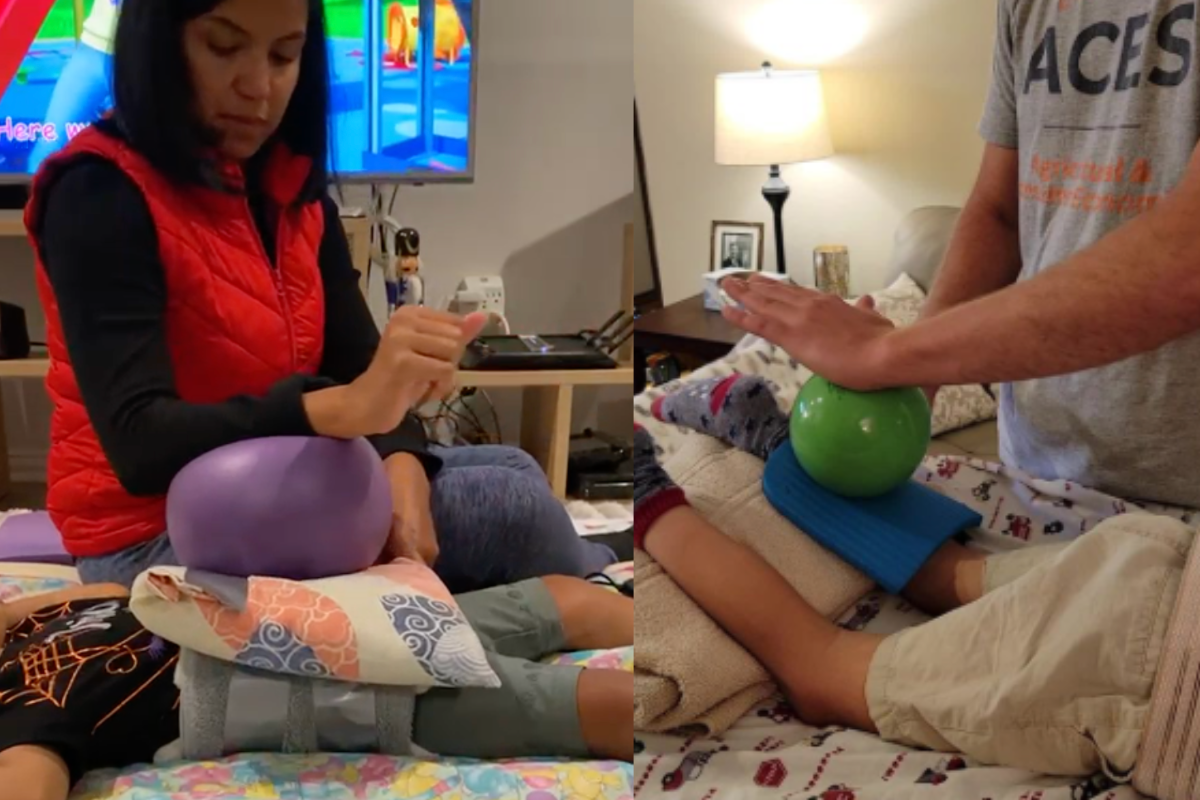
And each session? Just 20 minutes at a time. Most parents in our community work in two or three sessions throughout the day — but even one is more than what most children receive in a week of clinic visits.
The math is simple. The impact is profound.
We've been taught that real therapy happens in a clinic. That improving muscle tone, building head control, and developing posture in children with cerebral palsy requires specialized equipment and certified professionals. And while therapy teams are invaluable partners, consistent, gentle daily touch at home produces results that no weekly appointment can replicate on its own.
This is what we've seen with hundreds of families from all over the world — including parents in remote areas with no access to specialists, caregivers doing home therapy while managing full-time jobs, and grandmothers learning techniques to pass on to their families. When parents learn how to work with their child's body at home, something changes. Not overnight — but consistently, and lastingly.
What's Actually Driving Spasticity and Postural Collapse
To understand why home therapy works, we need to talk about something most approaches overlook: fascia.
Fascia is the connective tissue that wraps around every muscle, bone, nerve, and organ in the body. Think of it like the white membrane you see when you peel an orange — it's everywhere, it connects everything, and it gives the body its shape, tension, and structure.
In children with cerebral palsy, the fascial system often loses its proper tension. Instead of holding the body upright like a well-tensioned tent, it begins to collapse — like a tent with loose guylines. When that happens, the muscles have to work overtime just to keep the body stable. That muscular overwork is what we see as increased tone and spasticity.
Here's the paradigm shift that changes everything:
The tight muscles aren't the problem. They're the body's solution to a deeper imbalance.
Your child's spasticity, postural collapse, or limited head control isn't a sign that their muscles are broken. It's a sign that their fascial system needs more support — and their muscles are heroically picking up the slack.
And here's the hopeful part: fascia responds to gentle, repetitive stimulation. Small daily movements — soft pressure, light rolling, consistent touch — actually feed the fascial system and help it remodel over time. When the fascia strengthens and reorganizes, the muscles can finally let go. Tone reduces naturally. Posture improves. Movement becomes more fluid.
You don't need clinical equipment to do this. You need your hands, a few simple tools, and time.
A Grandmother, a Mountain, and a Child Who Changed
One of the families inside our WeFlow Bootcamp was determined from day one — even though she lived far from any specialized therapy center, with limited access to the kind of care many families take for granted.
She spent the first week learning the theory, building her tools, and practicing the techniques carefully before she ever started working with her grandchild. She was patient. She was consistent. And when she began — just a few minutes a day — she started to see shifts. Not dramatic overnight changes, but real ones. The kind that accumulates.
Her story isn't unusual in our community. We have families from across Africa, from islands with no pediatric neurologists, from remote towns where the nearest physio is hours away. What they all share is this: when they learn to work with their child's fascial system at home, something changes.
What Home Therapy for Cerebral Palsy Actually Looks Like
We're not talking about complicated, hour-long sessions that feel like a second job. We're talking about small, intentional moments woven into daily life.
A neck support — a simple soft wrap you can make at home — worn during car rides, TV time, or naps. It gently stimulates the base of the skull, calms the nervous system, improves head control, and creates stability without any active effort from your child. Many parents report their children sleeping longer and waking calmer from the very first week.
A soft ball and a steady hand, rolling gently over the abdomen or back while your child rests. Light pressure. Slow movement. Five to ten minutes. Parents consistently report improvements in bowel movements, breathing, and a reduction in overall muscle tension within the first few weeks.
An abdominal wrap — worn throughout the day, even during sleep. While your child breathes, the wrap creates gentle resistance that feeds the fascial system continuously. You're not even in the room, and the work is happening. Families report less spasticity, better sitting posture, and calmer tone over time.
These aren't shortcuts. They're grounded in how connective tissue actually remodels in response to mechanical input. Small, repeated stimulation is how fascia changes. And when fascia changes, motor skills improve, muscle tone reduces, and posture becomes more effortless — from the inside out.
You Don't Have to Choose Between Clinic and Home
This isn't about abandoning your child's therapy team. It's about recognizing that you have a role too — one that no clinic visit can fill, because no therapist is there at 7 in the morning when you're getting your child dressed, or at 9 at night when they're struggling to settle.
You are.
One mom in our bootcamp kept a spare ball in her purse and did a few minutes in the doctor's waiting room. Another worked during bath time. Another started with just the neck support during TV time — and called it a win. Because it was.
Every gentle touch, every moment of intentional contact, every time you wrap your child's torso or place the neck support before a car ride — that counts. That builds. That accumulates into something real.
You don't need a clinic to help your child with cerebral palsy. You need a method you trust, the confidence to use it, and the consistency to keep going.
That's what we're here to help you build.
Ready to Start?
Take your first step into fascia therapy with our short, parent-friendly workshop:
The #1 Fascia Therapy To Improve Torso Control
Gentle, effective, and easy to begin—no experience needed.
Want to Go Deeper?
If you’re ready to fully embrace this gentle approach and receive personalized support, apply for TheraParent Coaching—our therapeutic coaching program designed for dedicated parents like you.
Includes weekly calls, a tailored plan, and a supportive community.
Apply here – it’s free to explore.
Stay connected and inspired every week.
Subscribe to our weekly blog updates and receive new posts, encouragement, and fascia therapy tips right in
your inbox. So never miss the support and ideas that can make a difference in your journey.
