
Post 54: When the Body Finds a New Position: What It Means When Your Child Starts Rolling to Their Side
It happens quietly.
You walk into the room and your child is lying on their side. They weren't like that when you left. You didn't position them that way. They did it themselves.
For most parents, this moment passes without a second thought. But if your child has cerebral palsy — if you have spent years watching them lie on their back, unable to shift, unable to adjust, waking every time their body needed to move — this moment is anything but small.
It is, in fact, one of the most meaningful signs that something inside the body is genuinely changing.
Why This Matters More Than It Looks
Inside a recent TheraParent coaching call, two mothers shared almost the same observation within minutes of each other — without knowing the other was about to say it.
One noticed her daughter rolling to her side in bed. Something she had never done before. She had tried for years to encourage it, especially during the nights when reflux was making sleep dangerous. It had never happened spontaneously. And then one day, it did.
The other described her child adjusting position on the couch — legs moving, body shifting — on her own, without prompting.
Both mothers framed it as a small thing. Something they almost didn't mention.
I want to tell you why it isn't small at all.
The Spine Is the Key
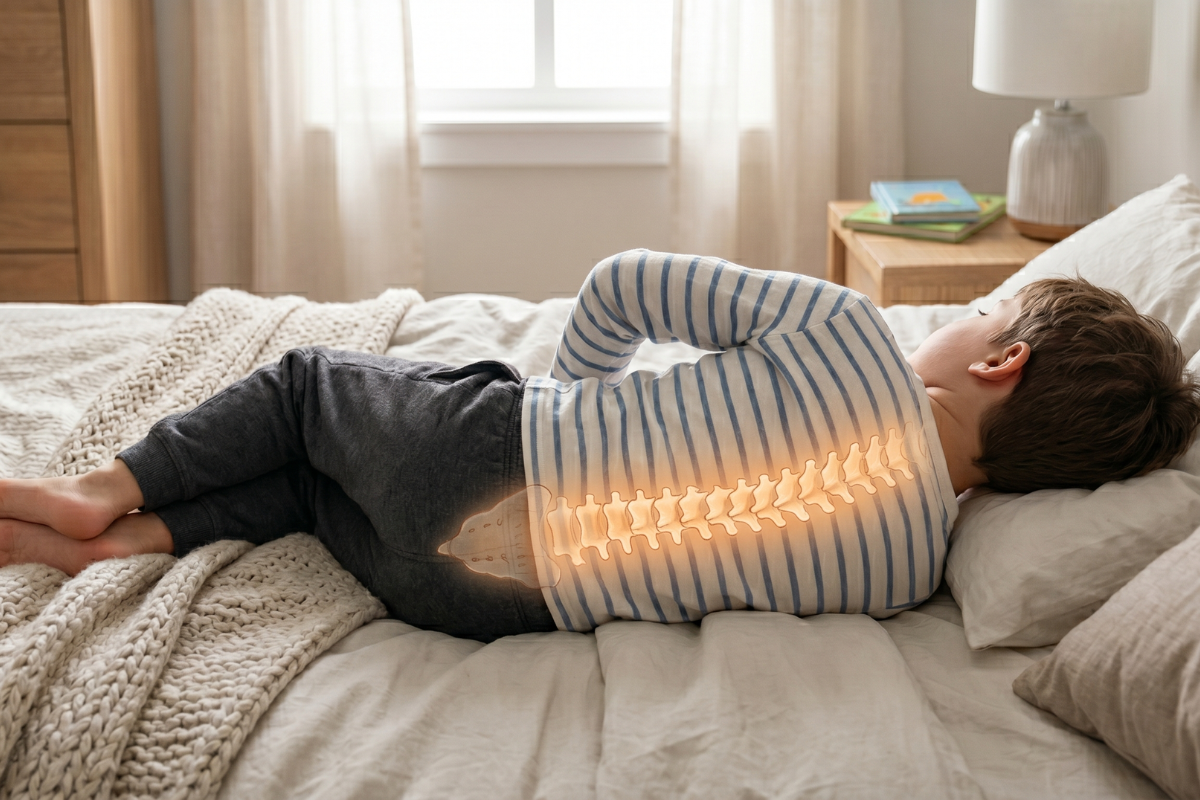
When a child with cerebral palsy struggles to roll, shift position, or self-adjust during sleep, the spine is almost always part of the story.
Not because the spine is broken. But because the connective tissue surrounding it — the fascia that wraps every vertebra, every disc, every muscle along the back — has been operating under chronic tension. That tension keeps the spine in a kind of guarded state. Stiff. Compressed. Reactive.
Imagine a spring that has been held compressed for a long time. When you try to bend it in a new direction, it resists — not because it can't move, but because the tension won't allow it to yield.
That's what we're working with when a child cannot comfortably roll to their side. The spine isn't just inflexible in the physical sense. It's operating as though any movement away from its default position is a threat. And so the whole body braces. The whole body resists.
This is also, by the way, why so many children with CP wake frequently during the night. A small adjustment in position — the kind you and I make dozens of times while sleeping without ever fully waking — becomes, for a child with a tense, reactive spine, a full-body event. The movement triggers the whole system. And suddenly they're awake.
As I've written about in the role of fascia in posture, head control, and torso stability, the fascial network doesn't operate in isolated segments — it responds as a whole. When the spine is held under tension, the entire body feels it.
What Spine Flexibility Actually Means
Here's something I want you to understand, because it reframes everything.
When I talk about spine flexibility in the context of fascia therapy, I'm not talking about stretching. I'm not talking about range of motion exercises or spinal mobilization in the traditional sense.
I'm talking about fascia remodeling.
Fascia is living tissue. It responds to gentle, consistent input by gradually changing its structure — becoming more hydrated, more organized, more responsive. This is not a release in the way we might imagine something snapping loose or letting go. It's a slow, biological process of tissue reorganization. The fibroblasts — the cells that make up the fascial network — begin to remodel the tissue from the inside. Over weeks and months of consistent work, the quality of the tissue changes. It becomes less dense. Less guarded. More capable of transmitting movement fluidly.
And this is where biotensegrity becomes important.
Biotensegrity is the principle that the body maintains its structure through a dynamic balance of tension distributed across the entire connective tissue network. Every part of the system is in relationship with every other part. When the tension is well-distributed, the body moves with ease. When it isn't, the whole system becomes less fluid, less adaptable, less free.
In children with cerebral palsy, that tensional balance has been disrupted. A depleted fascial system is not capable of offering enough support to the body and we see abnormal tensional patterns instead.
What fascia therapy does, through gentle and consistent input, is gradually invite the tissue to remodel toward greater tensional balance. No single area is forced to change. Instead, the whole system is encouraged, over time, to redistribute. To find a more even, more functional relationship between all its parts.
And when that happens — when the body finds more tensional balance — the spine stops behaving like a rigid rod and starts behaving like what it actually is: a flexible, responsive, intelligent structure that can yield, adjust, and recover. Not because something let go, but because the whole body reorganized around it.
Why Rolling to the Side Is a Systemic Win
Let me explain what has to be true for a child to roll to their side and stay there comfortably.
First, the spine has to be flexible enough to allow the torso to rotate without resistance. If the fascia along the back is tight and reactive, the body will resist this rotation — or if it does roll, it will immediately want to come back to the default position.
Second, the torso has to be wide and stable enough to provide a surface to rest on. A compressed torso — one where the ribs are held inward, where the tissue is dense and unyielding — doesn't offer enough lateral surface area to feel stable on its side. The child rolls back because there's nothing to land on.
Third, the spine has to be capable of micro movements. This sounds subtle, but it's the piece that makes everything else possible. A spine that has remodeled toward greater tensional balance is not just more flexible — it's more stable at the same time. That combination allows each segment of the spine to participate in the movement individually, passing it along fluidly from one vertebra to the next, rather than the whole structure bracing and moving as one rigid unit. When those micro movements are present, rolling to the side stops being an effort. It becomes something the body simply does.
When a child rolls to their side and stays — calmly, voluntarily, without distress — all three of those things are happening. The spine is yielding. The torso is stable. The movement is integrated.
That is a full-body reorganization. Expressed in one quiet moment.
What This Looks Like in the Weeks Before
One of the things I love most about working with families inside TheraParent is watching the sequence of events that leads up to a moment like this.
It doesn't come out of nowhere.
In the weeks before a child rolls spontaneously for the first time, parents usually report a cluster of smaller changes. Sleep gets slightly longer. The child seems more settled during therapy. Muscle tone feels different under the hands — less braced, more responsive. Sometimes there are emotional releases — a few tears during a session, or unexpected laughter, or a deep sigh that seems to come from somewhere very old.
The body is preparing. The tissue is remodeling. The system is finding its balance.
And then one day, the child rolls to their side. And stays.
If you're in the early weeks of this work and you haven't seen this yet — you're likely already in that preparation phase. The changes are happening. They just haven't surfaced yet in a way you can see from across the room.
I wrote about what those early, quieter wins tend to look like in the first wins of fascia therapy — because I think it's important that parents know what to watch for before the bigger moments arrive.
A Note on Sleep
I want to go back to sleep for a moment, because it came up so clearly in this conversation.
If your child is waking frequently at night — and especially if they wake and seem distressed, or seem confused about why they woke — the spine is worth paying attention to.
Not the mattress. Not the pillow. Not the room temperature.
The spine.
When the fascia surrounding the spine begins to remodel, children often start sleeping longer within a matter of weeks. Not because we gave them a sleep intervention. But because the body no longer has to fully wake up to change position. The movement becomes fluid enough to happen below the surface of consciousness — the way it does for all of us when our bodies are at ease.
This is one of the most consistent observations families share inside TheraParent. And it's one of the most meaningful — because a child who sleeps better is a child whose body is getting the restoration it needs. And a parent who sleeps better is a parent who can show up differently the next morning.
What You Can Do With This
I'm not going to give you a technique to try at home from a blog post. The work that creates this kind of change is specific, layered, and needs to be learned properly — which is exactly what TheraParent Coaching is designed to do.
But what I want you to take from this is a shift in how you see these moments.
When your child rolls to their side, don't file it under "cute but probably random."
File it under: the spine is finding its flexibility. The body is reorganizing. We are on the right path.
Because you are.
Ready to Start?
Take your first step into fascia therapy with our short, parent-friendly workshop:
The #1 Fascia Therapy To Improve Torso Control. I teach you the first exercise and how to make the binder so you can help your child today.
Gentle, effective, and easy to begin—no experience needed.
Want to Go Deeper?
If you’re ready to fully embrace this gentle approach and receive personalized support, apply for TheraParent Coaching—our therapeutic coaching program designed for dedicated parents like you.
Includes weekly calls, a tailored plan, and a supportive community.
Apply here – it’s free to explore.
Stay connected and inspired every week.
Subscribe to our weekly blog updates and receive new posts, encouragement, and fascia therapy tips right in
your inbox. So never miss the support and ideas that can make a difference in your journey.
