
Post 40: Caregiver Burnout & Cerebral Palsy: How One Mom Found Her Way Back
I want to talk about something that doesn't come up enough in cerebral palsy conversations.
Not the therapy schedules. Not the milestone charts. Not the next intervention or the upcoming assessment.
I want to talk about you.
Because in over 25 years of working with families of children with cerebral palsy, I have watched some of the most devoted, intelligent, loving parents arrive at a point of complete and utter depletion. Not because they gave up. But because they gave everything — and the system they were giving it to was never designed to give much back.
If you are reading this at the end of a long day, or in the middle of a night you couldn't sleep through, or in a waiting room somewhere between one appointment and the next — I see you. And I want you to know that what you're feeling is not weakness. It's the entirely predictable result of carrying an enormous weight, largely alone, for a very long time.
The Weight Nobody Names
There's a specific kind of exhaustion that comes with being a caregiver for a child with cerebral palsy. I've seen it on the faces of mothers in my programs from all over the world — and it has a particular texture that goes beyond tiredness.
It's the exhaustion of never being off duty. Of waking up already calculating the day's logistics — transfers, medications, feeds, therapy exercises, school communications, insurance calls. Of loving your child so fiercely while simultaneously grieving the version of parenthood you imagined. Of holding hope and heartbreak in the same hands, every single day.
And underneath all of that, for so many parents, runs a quieter, more corrosive current: guilt.
Guilt that you're not doing enough. That you missed a therapy session. That you raised your voice last Tuesday. That you googled your child's condition at midnight and fell into a spiral of statistics and worst-case scenarios. That somewhere out there, another parent is working harder, doing more, getting better results — and you're falling behind.
I want to say something clearly about that guilt: it is lying to you.
The parents I work with are not falling behind. They are carrying more than most people will ever understand, and they are doing it with a love that is ferocious and quiet and relentless all at once. The guilt is not evidence of failure. It is evidence of how deeply they care.
When the System Adds to the Burden
Part of what makes caregiver burnout so common in the cerebral palsy world is that the traditional therapy model — however well-intentioned — can quietly reinforce the feeling that you are never doing enough.
You see a specialist once a week, maybe once a month. You leave with a list of exercises you're supposed to do at home every day. You try. Some days it works. Some days your child resists, or you're too tired, or life simply gets in the way. And then you arrive at the next appointment carrying the unspoken weight of everything you didn't manage to do.
I've heard this from hundreds of parents. The guilt of the missed sessions. The feeling of showing up to a clinic and quietly hoping the therapist won't ask how the home exercises went. The exhaustion of a system that depends entirely on your consistency but offers very little to sustain it.
This is not a criticism of therapists or therapy teams — many of them are extraordinary. But I've come to believe that the model itself can be part of the problem. When a parent's role is reduced to executing a list of exercises they barely understand, they lose something essential: the sense of agency, understanding, and genuine connection that makes the work feel meaningful rather than obligatory.
What One Mom Told Me
She joined the bootcamp working until late at night and waking early to manage her son's care before school. She had been doing this for years. She was competent and dedicated and, by the time she found us, quietly running on empty.
In one of our calls, she said something that stayed with me: "I feel like I'm always behind. Like there's always something more I should be doing, and I'm never doing it."
I asked her to tell me what she was already doing.
She listed it. The feeds. The positioning. The stretching. The school communications. The medical appointments. The research. The advocacy. The daily care that doesn't have a name or a chart or a congratulations attached to it.
There was a long pause.
"I've never actually said all of that out loud before," she told me.
What happened over the following weeks, as she learned fascia therapy and began working with her son at home, was not just physical. Yes — she started to see his tone soften, his sleep deepen, his body respond. Those changes were real and they mattered. But something else happened too.
She stopped feeling like she was executing a list of instructions someone else had written for her. She started feeling like she understood what she was doing and why. She started feeling like she was genuinely, meaningfully contributing to her son's wellbeing — not because a therapist told her to, but because she could feel it in her hands and see it in his face.
The guilt didn't disappear overnight. But it began, slowly, to lift.
What Changes When You Have a Method You Trust
I've thought a lot about why fascia therapy seems to help not just the children — but the parents.
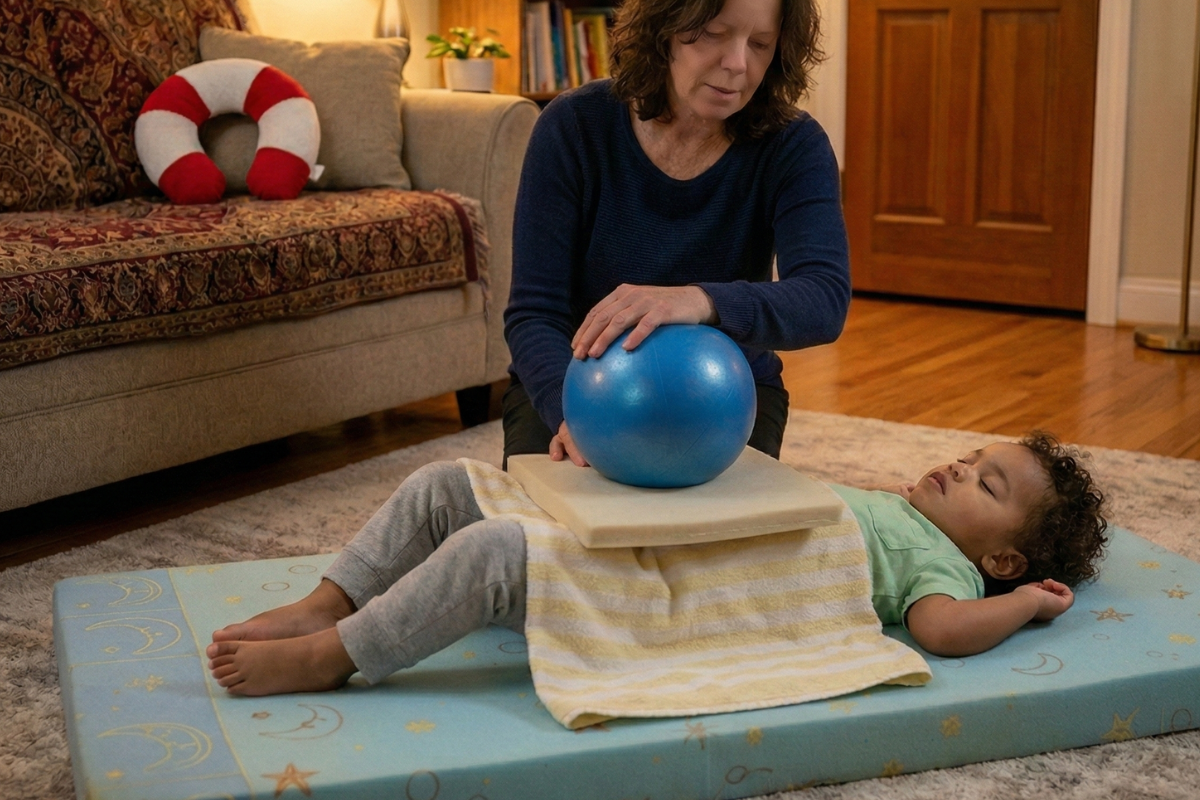
Part of it is practical. The techniques are gentle, quiet, and can be done in twenty minutes at a time. They don't require a perfect day or a cooperative child. They can happen during nap time, during TV time, even while the child sleeps. For parents who have spent years trying to find thirty minutes in an already impossible schedule, this matters enormously.
But I think there's something deeper happening too.
When you understand why you're doing something — when the work makes sense to you on a body level, not just as a protocol you've been handed — it stops feeling like an obligation and starts feeling like a gift. Like something you're choosing to give your child, in your own home, with your own hands, in a way that no clinic visit can replicate.
And when your child begins to relax into your touch — when you feel their breathing slow and their muscles soften under your hands — something happens to you too. A connection reestablishes itself. A sense of capability and purpose that exhaustion had quietly eroded begins to return.
I have watched this happen over and over again. Parents who arrived depleted and doubting, who left — not perfect, not without hard days — but feeling something they had not felt in a long time.
Useful. Present. Enough.
You Cannot Pour From an Empty Cup — But You Also Cannot Wait Until It's Full
I know the advice to "take care of yourself first" can feel tone-deaf when you are in the thick of caregiving. There is no easy gap in the schedule for self-care. There is no uncomplicated way to rest when your child needs you.
So I'm not going to tell you to rest more, or stress less, or find time for yourself. What I am going to tell you is this:
Having a method that works — one that you understand, that fits into your life, that actually produces results you can see and feel — is itself a form of relief.
It doesn't fix everything. It doesn't erase the hard days or the grief or the impossible logistics. But it changes something fundamental about how you show up. Because when you stop feeling like you're failing, some of the weight lifts. When you stop feeling alone in the work, the isolation loosens. When you see your child respond — really respond — hope comes back.
And hope, I have learned, is not a luxury. For the parents I work with, it is fuel.
You are not behind. You are not failing. You are doing something extraordinary, every single day, in conditions that most people will never fully understand.
And you deserve to feel that.
Ready to Start?
Take your first step into fascia therapy with our short, parent-friendly workshop:
The #1 Fascia Therapy To Improve Torso Control
Gentle, effective, and easy to begin—no experience needed.
Want to Go Deeper?
If you’re ready to fully embrace this gentle approach and receive personalized support, apply for TheraParent Coaching—our therapeutic coaching program designed for dedicated parents like you.
Includes weekly calls, a tailored plan, and a supportive community.
Apply here – it’s free to explore.
Stay connected and inspired every week.
Subscribe to our weekly blog updates and receive new posts, encouragement, and fascia therapy tips right in
your inbox. So never miss the support and ideas that can make a difference in your journey.
