Post 39: Cerebral Palsy Home Therapy: A Mother's Journey Inside the Bootcamp
A Month Inside the Bootcamp: One Mother's Story
She came to the bootcamp exhausted.
Not the kind of tired that a good night's sleep fixes — the kind that settles into your bones after years of appointments, assessments, therapies, and the quiet, relentless work of caring for a child whose body fights them every single day.
Her son has spastic cerebral palsy. He is 13 years old. And this mom had spent over a decade doing everything she could — every therapy, every recommendation, every new approach that came her way.
She wasn't looking for a miracle. She had stopped expecting those a long time ago. She was just hoping, quietly, for something to feel different.
Week One: Learning to Be Still
The first week of the bootcamp isn't about doing. It's about learning.
I ask parents to watch, to understand, to build their tools and practice the techniques before they ever begin working with their child. For many parents, this is harder than it sounds. They are used to action. They are used to doing.
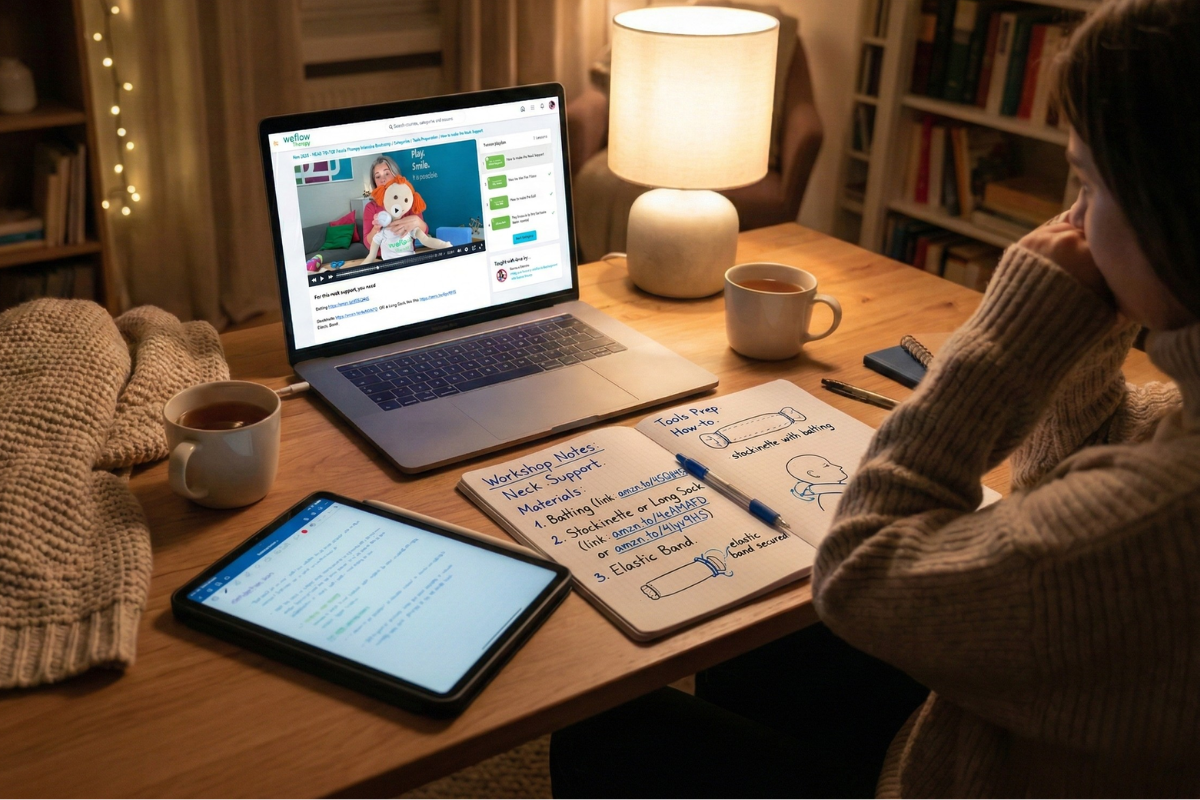
This mom told me she found herself watching the videos at midnight, the house finally quiet, taking notes like a student preparing for an exam. She built his neck support carefully, measured the batting, practiced the technique on her own arm before she trusted herself to try it.
"I kept thinking I was going to do it wrong," she told me. "I kept second-guessing my pressure, my position, everything."
That feeling — that anxious desire to get it right — is something I hear from almost every parent in the first week. It comes from love. It comes from knowing how much is at stake. And it always, always softens with time.
Week Two: The First Surprise
By the second week, she had started working with her son. Gently. Carefully. Twenty minutes at a time, in the evenings after dinner when he was calm.
She wasn't expecting much yet. She had told herself to be patient.
And then, one morning, she noticed something.
Her son's thumbs — which had curled tightly inward for as long as she could remember, locked inside clenched fists — were resting outside his hands.
She didn't say anything at first. She thought maybe it was a coincidence. She watched for a few more days.
They kept resting there.
"I didn't even know that was something that could change," she told me during our call, her voice catching slightly. "After 13 years, I honestly didn't know."
This is the moment I live for as a therapist. Not because the thumbs are the point — but because of what they represent. The body responded. The tissue softening. The system began to reorganize in ways that 13 years of other approaches — physical therapy, spasticity management, orthotics, stretching — had not reached.
Week Three: Building Confidence
By the third week, something had shifted in her too — not just in her son.
She was moving through the sessions with more ease. Her shoulders had dropped. She wasn't second-guessing every movement. She had found a rhythm — a way of being present with him during those twenty minutes that felt less like therapy and more like connection.
He had started closing his eyes during sessions. Relaxing his jaw. Breathing more slowly.
"He looks forward to it," this mom told me. "I can tell."
I hear this often, and it never stops meaning something to me. Children whose bodies have been tight, resistant, and defended for years — whose muscle tone has been constantly elevated, whose nervous systems have been on high alert — begin to seek out this kind of touch. Because the body knows. When something is genuinely helping — when the input is the right quality, in the right place, with the right intention — the nervous system recognizes it. It stops bracing. It begins to receive.
Week Four: Trusting the Process
By the end of the first month, the changes she could point to were not dramatic by the standards of milestone charts.
Her son was not suddenly sitting with better trunk control. He was not holding his head up for longer periods. He was not reaching or grasping in new ways.
But here is what had changed:
He was sleeping more deeply. His bowel movements had become more regular — something that had been a daily struggle for years, as it is for so many children with cerebral palsy. His legs were easier to open during dressing, his muscle tightness visibly softer. His overall tone, while still present, had a different quality — less defended, more yielding under her hands.
And she had stopped lying awake at night asking if any of it was working.
Because she knew.
She could feel it in her hands. She could see it in his face. She could hear it in the longer, quieter exhales at the end of every session.
Something was building. Slowly, carefully, structurally — something was building.
What I Want You to Take From This Story
I share this story not because it is exceptional — but because it is not.
I have seen versions of this unfold with families from all over the world. Parents of children of all ages — toddlers, school-age kids, teenagers with spastic cerebral palsy who have been in and out of clinics their whole lives — who came in exhausted and skeptical, who learned to trust their hands, who showed up consistently for twenty minutes at a time, and who began to see their child's body respond in ways they had stopped expecting.
The changes don't always come in the order you want. They don't always look the way you imagined. But they come.
And they come because you showed up. Because you were gentle and consistent and willing to learn. Because you chose to be the one — not the therapist, not the clinic, not the next specialist — but you, in the quiet of your own home, with your own hands.
That is not nothing. That is everything.
If you are somewhere in your own week one right now — uncertain, second-guessing, wondering if you're doing it right — I want you to know that this is exactly where the story begins.
Keep going.
Ready to Start?
Take your first step into fascia therapy with our short, parent-friendly workshop:
The #1 Fascia Therapy To Improve Torso Control
Gentle, effective, and easy to begin—no experience needed.
Want to Go Deeper?
If you’re ready to fully embrace this gentle approach and receive personalized support, apply for TheraParent Coaching—our therapeutic coaching program designed for dedicated parents like you.
Includes weekly calls, a tailored plan, and a supportive community.
Apply here – it’s free to explore.
Stay connected and inspired every week.
Subscribe to our weekly blog updates and receive new posts, encouragement, and fascia therapy tips right in
your inbox. So never miss the support and ideas that can make a difference in your journey.
